

System Depth37 Visual ReadingsAcross eyes, brows, lashes & facial balance
From the mind of PSC Lashes
The mind of a lash designer, in the chair with you.
PSC's analysis, method and eye, engineered into a system you run for every client. Insert the PSC system into your business, and design from her face, not from a reference photo.
A system fully injected with the PSC methodology, reading her landmarks, tilt and proportions the way a trained designer would, in seconds.
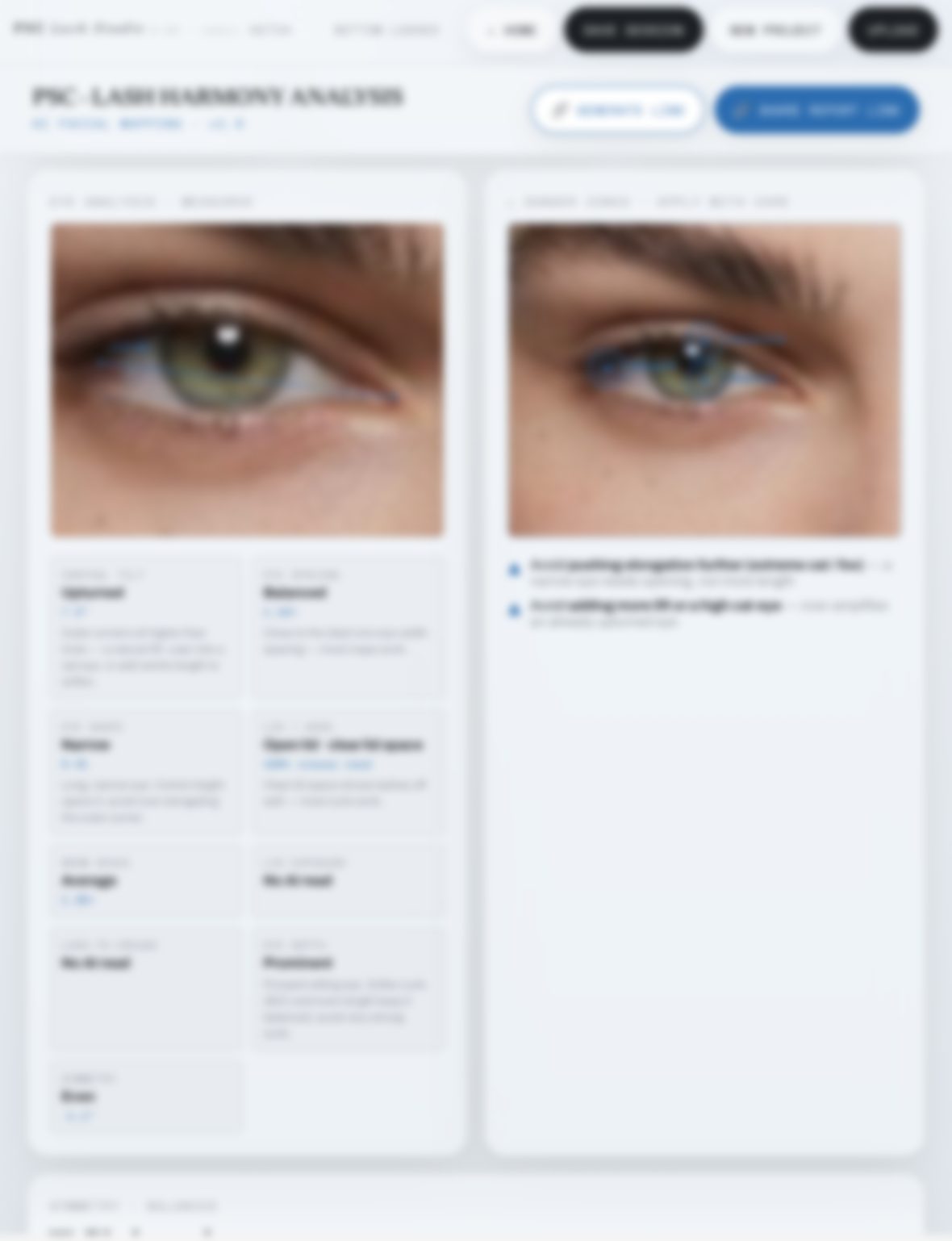
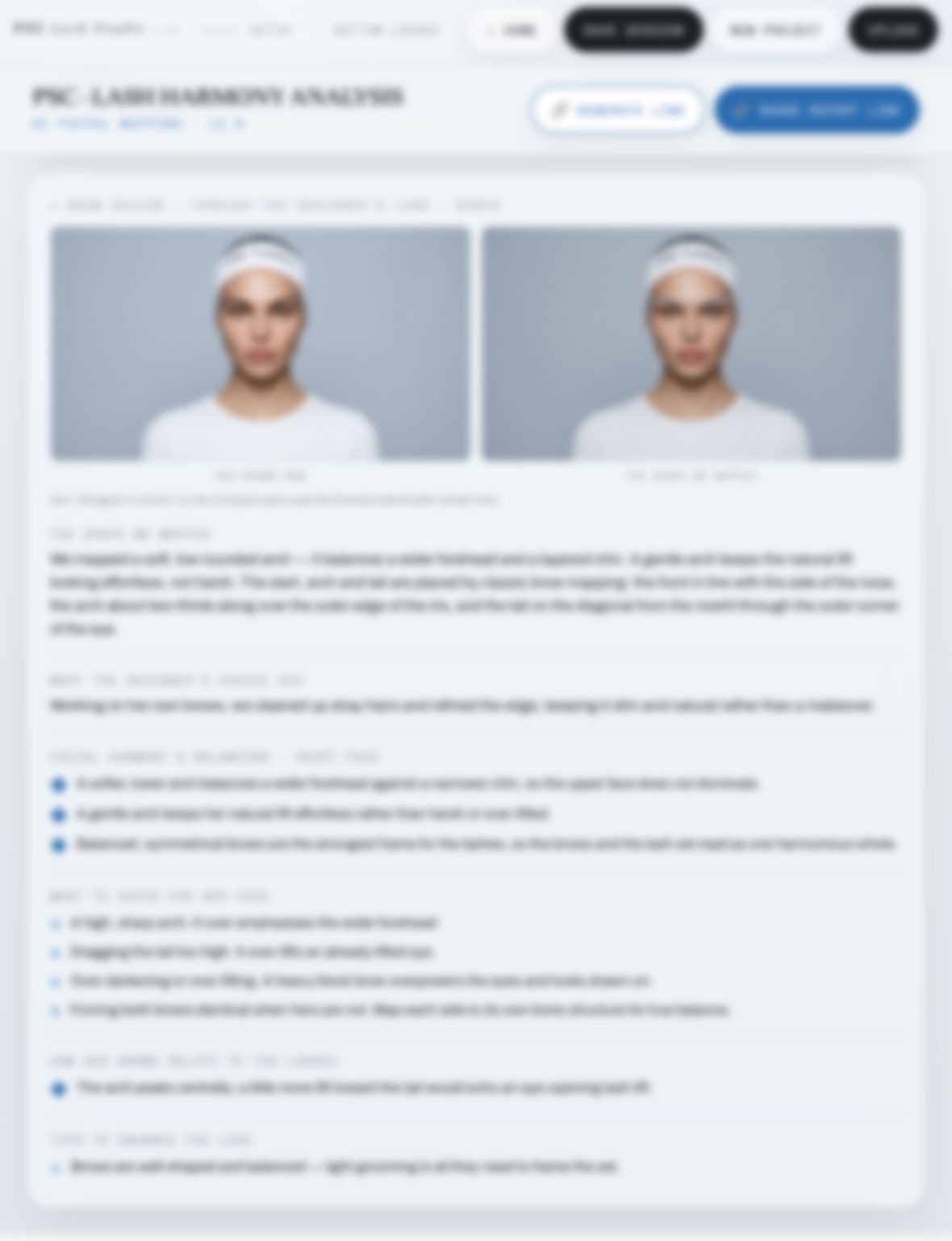
EYEEye analysisBROWBrow analysis
Live in app
Live in app
This is PSC, in a system
The mind of PSC Lashes, at your fingertips.
Artists have flown in from across the world to learn how PSC reads an eye. PSC sets have gone viral, sat on luxury clients, and been studied by lash artists everywhere.
Six years of lash design and artistry, the analysis and instinct behind every set, injected into a system. Built and refined over two years, on serious infrastructure, so that for the first time the mind of a designer lives at your fingertips, for every client you sit down.
6 years of designBuilt over 2 yearsTrained in person, limited intakeSets that go viralOn luxury clientsStudied worldwide
Designed, not generated
See the PSC design on her own eyes.
Drag to reveal what the system designed, and why. Every choice traces back to her eye-shape analysis, not a guess.
AnalyseSketchVisualise
The analysis is done for you.
Full analysisPSC design grid
The analysis is accurate, engineered from thousands of facial analyses noted by PSC, not guessed. From there you freehand the sketch yourself, on her own eyes, guided by the analysis and the look she is envisioning. The Designer Lab then renders the final set, combining your lash design with PSC design methods, for the look most suited to her unique features.
Visualise
From sketch to a hyper-realistic visual, on your client.
Designed with PSC methodology, the final look is engineered for her unique features. Then all you have to do is replicate it, with the report in hand.
psc-designer / ai-render
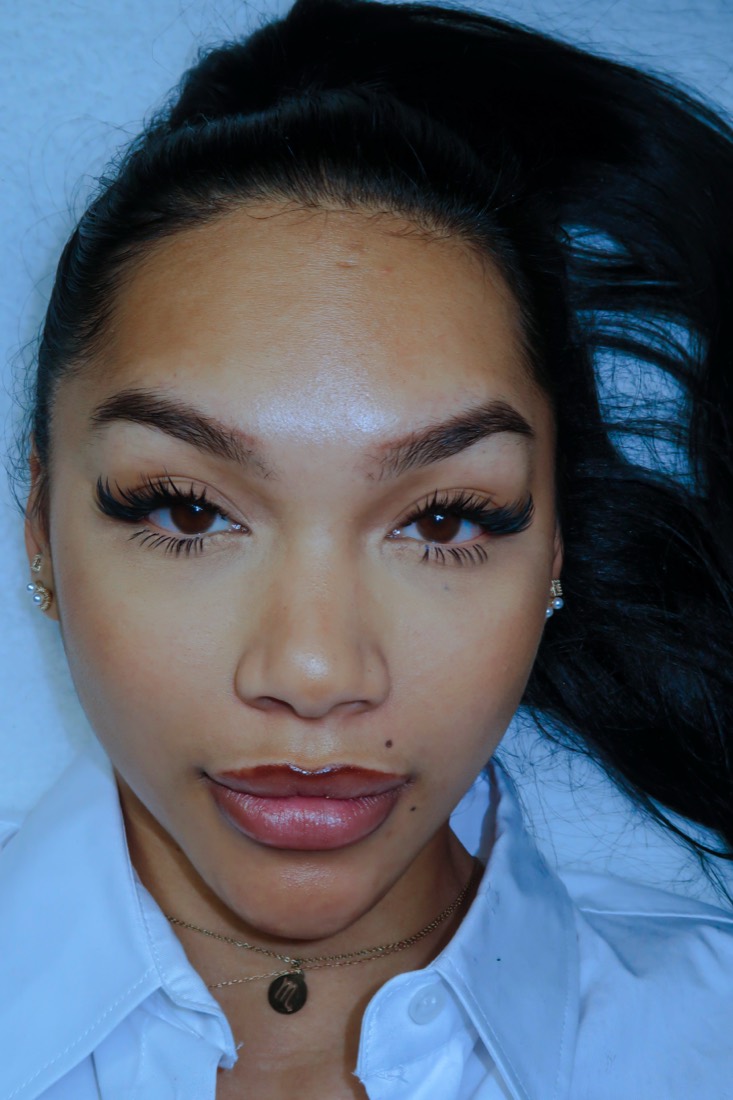
BareAI render
Lift at the outer cornerHer tilt reads neutral, so the design adds upward movement.
Open through the centreBuilt around her natural almond shape, not a trend.
Brow framed to support the eyeA balanced brow keeps the lift reading intentional, not heavy.
Design intentionLift · Open · Balance
Drag to compare: her bare eyes to the AI-rendered set. Designed with PSC methodology integrated into the AI, engineered from her eye-shape analysis, not guessed.
Real client usage
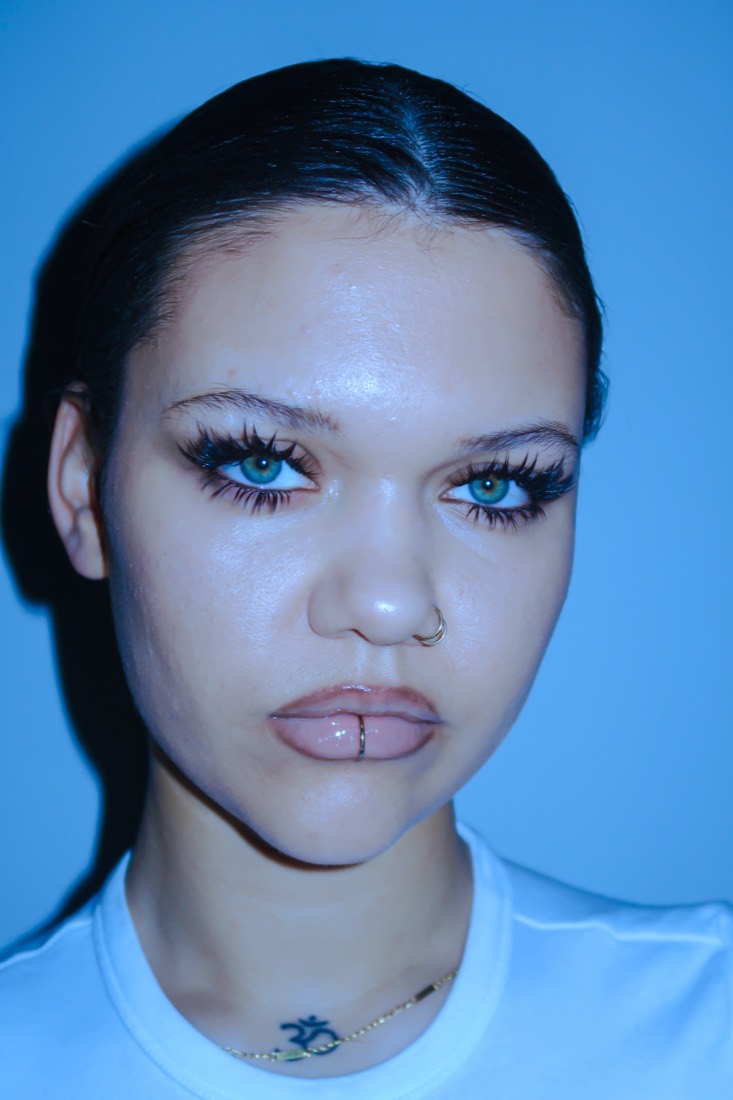
A real client, before application.
A real appointment. The after is an AI render generated through the PSC system. It looks like real lashes, but it is a preview of her set, on her own face, before a single one is applied.
psc-designer / real-appointment
BareAI render
Drag to compare. The after is AI-rendered through the system, not a photo of applied lashes.
She sees the result before the tweezers are picked up.
This is not a beauty filter, and not a generic AI you can prompt somewhere else. The preview is built in collaboration with your own sketch, engineered from a real eye analysis and the PSC design methodology in the system. The AI renders the design you drew, so every result is designed on purpose, from the analysis and your sketch up, not randomly generated. She sees what a PSC-trained designer would build, because that is exactly what is running behind it.
High-fidelity AI visualisation
Not a cheap filter. A premium visual preview.
The AI preview is one of the most important parts of the consultation. Your client is not looking at a generic beauty filter or a low-quality lash overlay. She is seeing a high-fidelity visualisation created from her own image, your design sketch, and the consultation logic behind the recommendation.
PSC uses premium visual AI infrastructure to create previews that feel polished, realistic, and client-presentable. Because if the consultation is supposed to help you charge premium, the visual result cannot feel cheap.
PSC methodology is integrated into the AI, so it designs from analysis, not guesswork. The artist still leads. The AI simply helps the client see it.
The visual consultation
The consultation your client can finally see.
PSC turns your design process into a visual flow, from analysis, to sketch, to AI preview, to a client-ready report.
01Analyse02Sketch03Preview04Report
This is the report she walks away with.
Inside the report
Everything she walks away with.
Most clients never understand why a set did, or did not, suit them. The report explains it from her own analysis, trained on PSC methodology: why a past set may have fought her features, what actually suits her, and the exact design built for her face.
Recommended lash map
The design the system recommends for her, built on PSC methodology, not a guess.
Curl combination
The exact curl mix for her eye, from the PSC method.
Full eye-shape analysis
Every measured feature of her eye, explained simply.
Brow analysis (bonus)
A read on how her brows frame the eye and the set.
Harmony score
Her overall balance rating, and what it means for the design.
Sets that suit her
The styles to go for, matched to her features.
What to avoid
Styles and danger zones that have worked against her before.
Hidden asymmetry
Differences between her eyes she may never have known about.
Her best features
What the design leans into, drawn from her own face.
Before and after
The AI visualisation of her set, on her own eyes.
The lash sketch
Her map, drawn in sketch mode, included in the report.
Share or keep
Send her a link, or save every report in your client database.
Every report is trained on PSC methods, so she leaves understanding her own eyes. Share the link with her, or keep it in your client database.
The designer
Built from the mind of a premium lash designer.
The intelligence behind PSC is trained on real design work, so it reads, reasons and recommends like a premium lash designer. This is the PSC methodology built into the AI. It is not a generic tool you could recreate in a chat app.
Reads the eye
It assesses the eye, brow, lid and facial balance the way a trained designer does, across thousands of real faces.
Reasons with intention
Every recommendation follows the PSC design logic, the lift, the balance, the intention. Not a generic filter.
Built on real expertise
Thousands of real cases and the same method taught in person, on a limited intake, distilled into one consultation intelligence.
"I have been asked so many times to create a lash map ebook, and I always refused. A map I draw on my model, in front of me, will never translate to your client, in your chair. That is exactly why I built this instead. This is not a lash map ebook, and nothing about it compares to one."
"I built the PSC Designer Eye because lash artists deserve more than words. They deserve a way to show the client the thought, structure and artistry behind the set."
Every design the system produces, and every report it hands your client, is built on real PSC methodology. The named techniques behind her signature work.
Lash maps with PSC techniques
Every map follows the design logic behind her signature sets.
Intentional chaos
Controlled irregularity so the set reads natural and lived-in, never uniform.
Shadowing effect
Depth and dimension engineered into the set, the way she builds it.
Intentional deviations
Deliberate directional breaks that open and lift the eye on purpose.
Zone architecture design, E*
The eye built in zones, resolved at the outer tip.
Curl engineering
Curl chosen and mixed to the lid and angle, never a default.
Layer architecture
Length and layers structured for balance, and for how it photographs.
Customised lash designs
Every set designed to her features, never a template.
Full eye and facial anatomy analysis
The whole eye, brow and facial balance read before a single lash.
The full PSC design system, applied in the analysis and named in her report. Go deeper with each of them in PSC training.
The problem
The industry has treated lash design like a style choice.
But real design starts long before the first lash is applied. Most clients do not know what their eyes need. They know what they have seen on Pinterest, Instagram or someone else's face.
Most artists are expected to translate that request into a flattering set, often with no structured consultation, no visual explanation, and no way to show the client why one design works better than another. That is where the gap begins.
Scroll to explore
01
Clients ask for styles, not strategy.
A client may ask for cat eye, doll eye, wispy, natural or full volume. But she is not really asking for a lash map.
She is asking to look lifted, softer, more open, more feminine, more defined or more balanced. The problem is that she does not always have the language for that.
02
Most lash artists were never taught to read an eye.
Application is taught everywhere. Analysis almost nowhere. The hard truth is that most artists can apply beautifully, but were never shown how to actually read an eye or build a map for it. So they copy a reference photo onto a face it was never designed for, and hope it suits her.
Eye shape, lid visibility, crease structure, canthal tilt, eye spacing, brow position and lash direction all change the right design. Without a system to read them, every set is a guess that happened to land, or didn't.
03
The consultation is too invisible.
A premium artist may be making advanced decisions in her head. But if the client cannot see that thinking, she only sees the final application.
Why the outer corner was softenedWhy the centre was openedWhy density was controlledWhy the brow reframes the eye
04
Clients do not always see artists as specialists.
Not because the skill is not there. Because the consultation does not always prove it.
When the client is asked "what style do you want?" the service feels like a menu. When she is walked through her eye, brow, design direction, preview and report, it feels like a professional consultation.
05
Premium pricing needs a premium process.
You cannot charge like a specialist while consulting like a technician. Premium clients need more than your word.
See the analysisUnderstand the designFeel the expertiseTrust the recommendation
The mindset shift
You're not charging for lashes.
And if you think you are, that is exactly why you are underpaid.
What clients are really paying for is perception design. How their eyes sit. How their face reads. How they feel when they look at themselves.
Most artists focus on application. A designer decides the outcome before contact: where the lift comes from, how the eye will open, what gets softened or enhanced, and how the set will photograph in different lighting.
By the time the tile opens, the set is already finished in her head. The application is just execution.
That is the difference between a lash tech and a lash designer. Clients pay premium for a designer.
Rachel, PSC Lashes
The shift
Two consultations. Two very different clients.
The old way
A few quick questions
Step 1"So, what do you want?"
Step 2Copy a Pinterest photo
Step 3No eye or brow analysis
Step 4Apply without a plan
Step 5Client leaves underwhelmed
The PSC way
A structured visual consultation
Step 1Analyse the eye & browThe design fits her face, not a trend.
Step 2Explain what suits herShe understands the choice and trusts it.
Step 3Sketch & AI previewShe sees the result before you start.
Step 4Hand her a reportShe leaves with proof, not just a set.
Step 5Client books againBecause the experience felt expert.
Professional-grade analysis
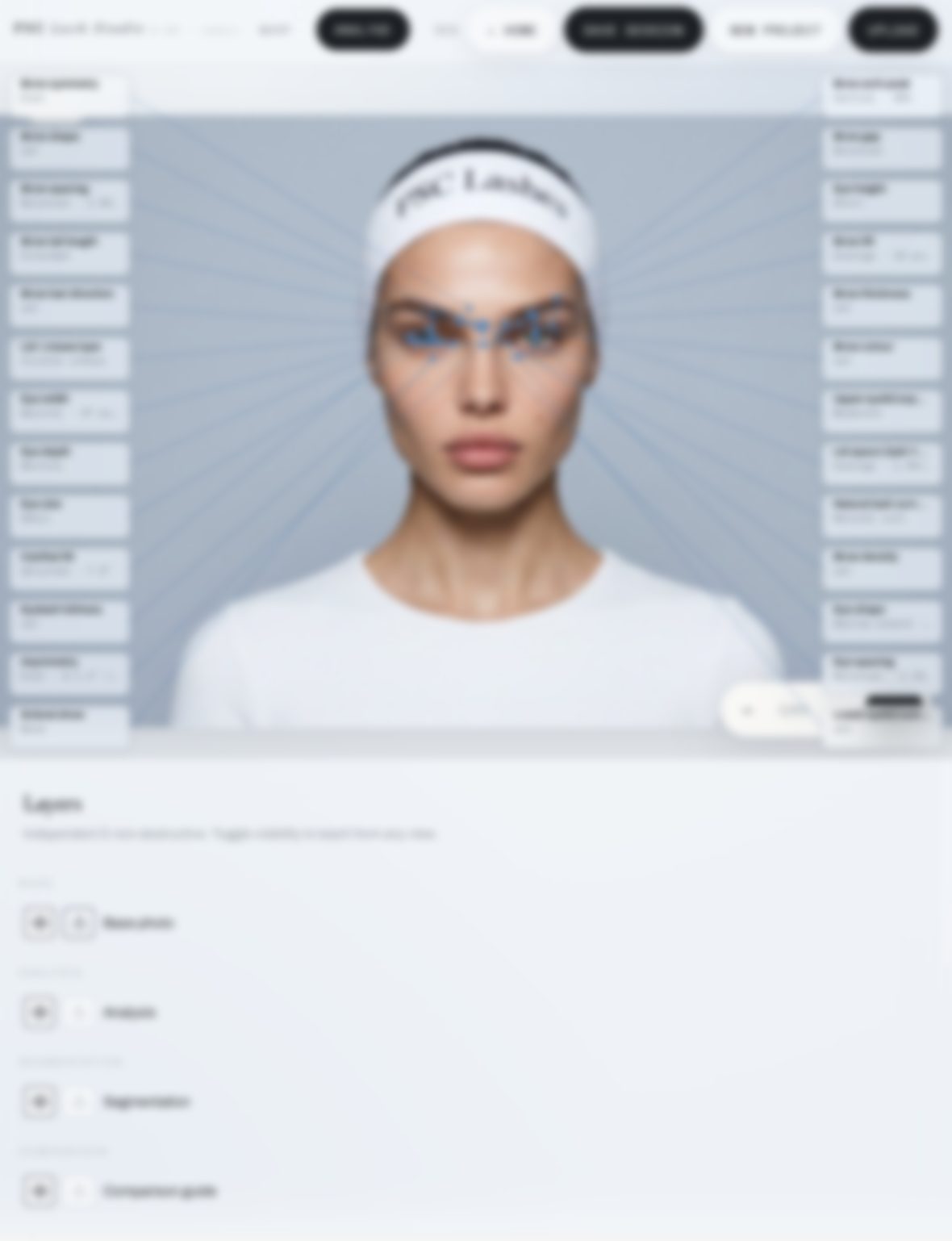
37 visual readings across the eye and brow area.
Every consultation runs through a structured analysis of the features that influence lash design, from eye shape and lid visibility to brow position, lash direction and facial balance. Not to judge the face. To understand how to design around it. Because lashes do not exist alone. The brows frame the eye. The lashes shape the expression. PSC helps artists read the full eye area before creating the final design.
Each test produces a measured value or classification that feeds into the harmony score and shapes the design recommendation, for both lash and brow work.
The professional consultation
Stop applying lashes. Start selling the design.
Most artists ask "what style do you want?" and price like a technician. A structured, visual consultation changes what you are selling, and what you can charge for it.
01
Charge for the consultation
Run your analysis as a paid, premium service. Clients pay for the design thinking, not just the application.
02
Price like a specialist
A visual, structured process lifts you above everyone working from a style menu. You stop competing on price.
03
Win the yes faster
When the client sees the reasoning behind the set, the value is obvious and the price stops being the conversation.
04
Look unmistakably professional
A clinical, iPad-led consultation feels like a specialist appointment, not a quick chat before the tweezers.
Screen recordingA client sitting through the consultation on the iPad, the analysis building into a premium report
A consultation this professional is one clients expect to pay for, and one that justifies your price before you pick up the tweezers.
The deliverable
A consultation she can see, understand and remember.
Your sketch, in her report
You draw it. You deliver it.
You sketch her set yourself with the hyper-realistic brushes, and she receives it exactly like this, a high-quality PSC-style sketch in her report. Your design, your hand, made client-ready.
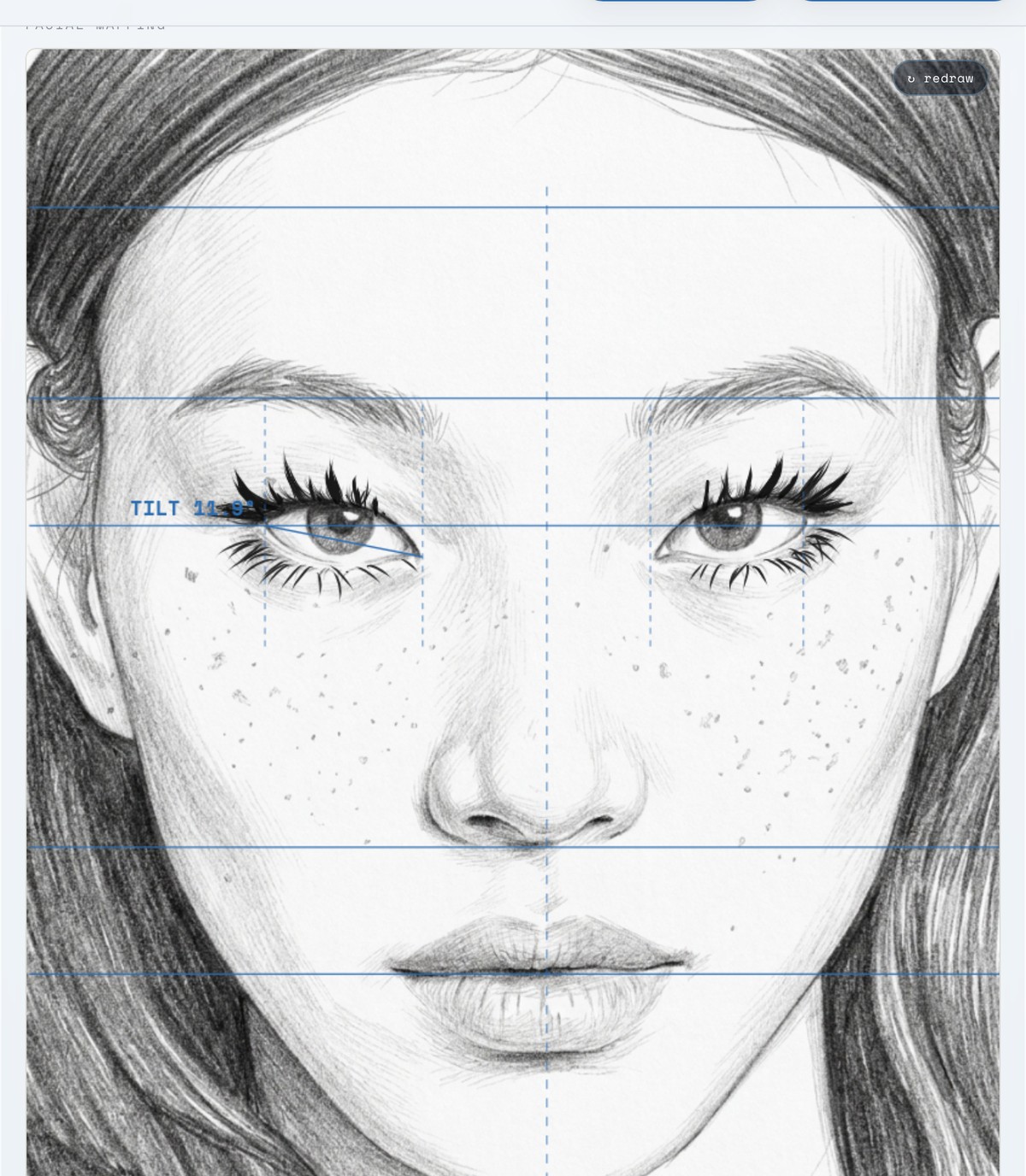
Her photoFacial mappingMapped by PSCLash map
PSC · Lash Harmony AnalysisAI Facial Mapping
Canthal TiltUpturned · 8.8°
Eye SpacingBalanced
Eye ShapeNarrow almond
Lid / CreaseHooded
SymmetryEven
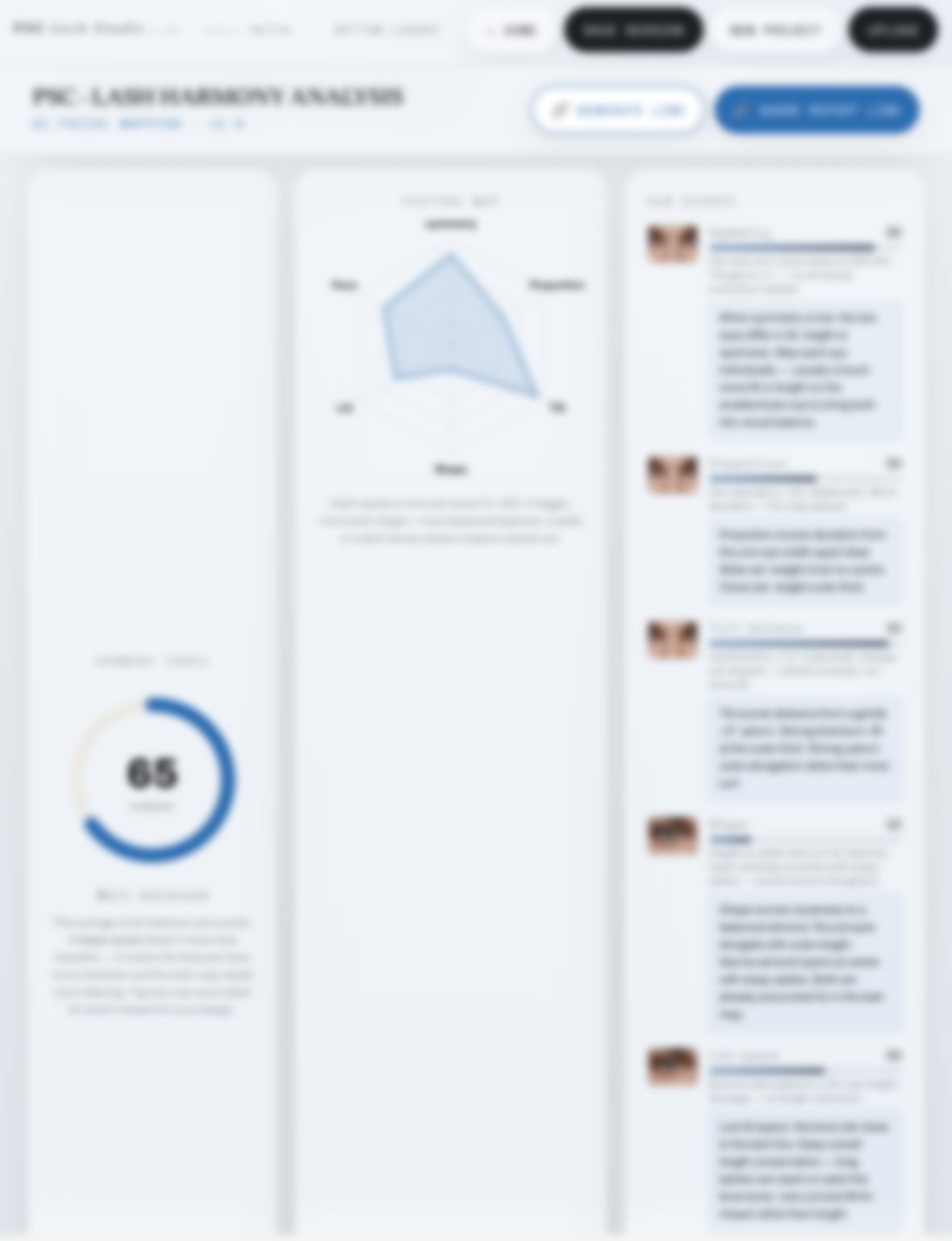
Harmony Index 92Balanced design across the full face
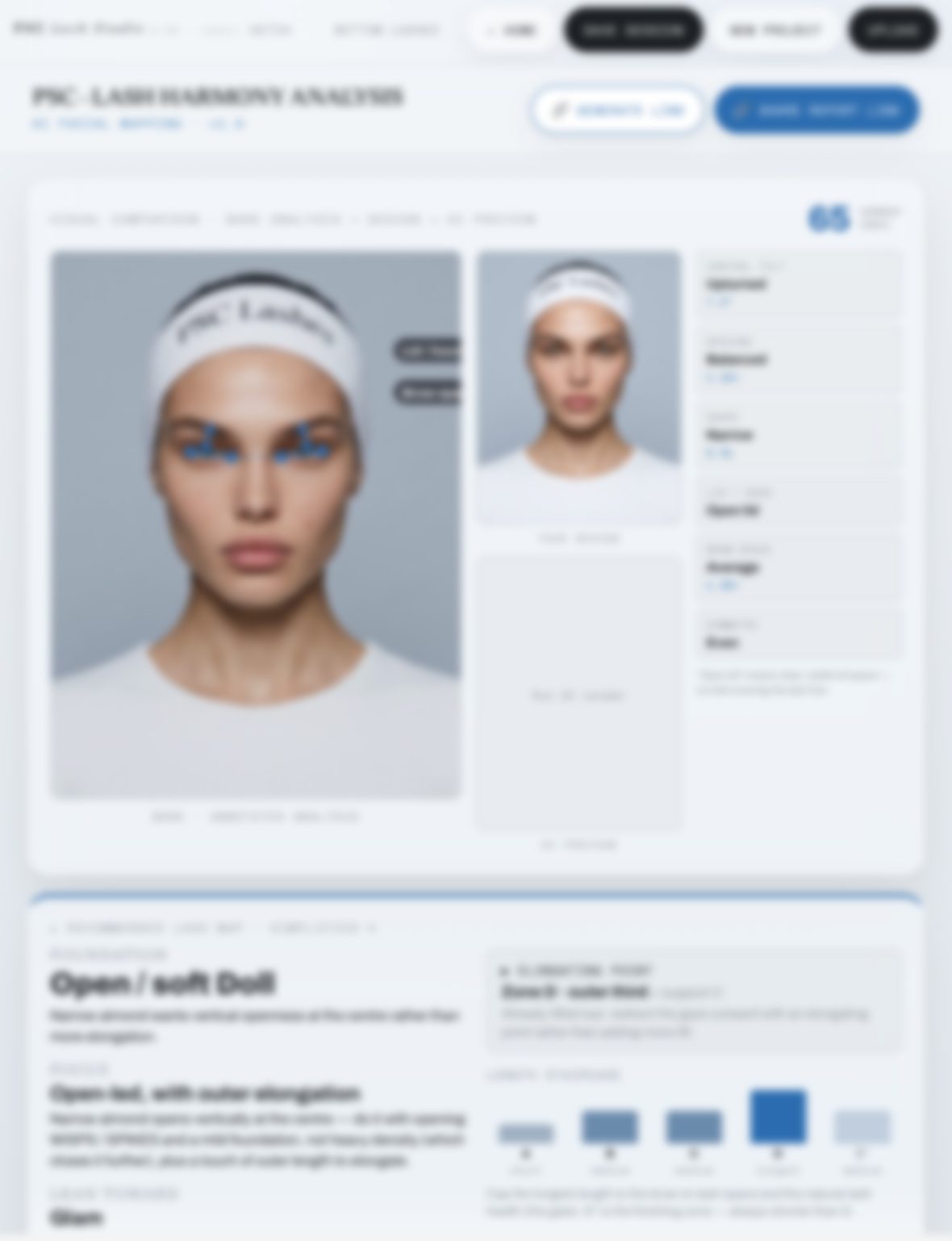
ImageA real client report: analysis, sketch, preview and recommendation on one page
The report can include
Eye analysis
Design intention
Recommended map
Curl direction
Length structure
Styling notes
What to avoid
Why this design suits her
Future appointment notes
This builds trust before the service begins.
Send it. Share it. Keep it.
Export the consultation report as a shareable document your client can keep. She leaves with more than a set. She leaves with a record of the design, the reasoning, and the analysis. That is the experience she remembers and recommends.
Export as PDF
A polished document she can save or screenshot.
Share link
Send a live report link directly to the client.
Print-ready
Professional enough to frame in your studio.
Client profiles
A design database, not a filing cabinet.
Every consultation builds your library. Every client has a profile. Every design is saved, searchable, and ready for her next appointment.
Consultation history
Walk through facial features with a structured consultation flow. The questions are designed to surface what matters for the design, not just what the client thinks she wants. Every answer feeds the report.
Saved designs & sketches
Every sketch, every analysis, every report, stored against the client. When she returns in 3 weeks, you open her profile and pick up exactly where you left off. No re-asking, no re-analysing.
Design intelligence over time
The more you use the system, the richer your design database becomes. See patterns across clients. Refine your approach. Build a body of work that proves your expertise.
Why it works
More than a consultation. A way to grow.
You cannot charge premium prices with a basic consultation. This changes how clients see you, how you market, and how you charge.
01
You become the specialist in the room.
When a client watches you read and design her own eyes, the expertise stops being something you claim. She sees it. That is what lets you price like a specialist, not a technician.
02
You charge for the consultation itself.
The analysis becomes a service in its own right. A premium, paid experience, not a quick chat before application. And every preview you create is content worth sharing, the kind that quietly fills your books.
03
Clients say yes faster, and stay.
When she understands the reasoning behind her set, the value is obvious and the price stops being the conversation. Her analysis stays on file, so every appointment after is faster, sharper and unmistakably yours.
For educators
Teach the art of lash design.
For educators and academies, the Designer Lab turns your method into a teachable, visual system, so students learn to design, not just apply.
Teach design, not just application
Show students the reasoning behind every set, not only the technique.
Make the invisible visible
The eye analysis, the map, the danger zones, all on screen for the class.
Standardise your curriculum
Every student learns the same structured PSC method, the same way.
A flagship for premium courses
Add the Designer Lab to your education as a signature, paid tool.
Students learn faster
Visual analysis lands harder than verbal explanation, and it sticks.
Demonstrate live, on any face
Show design decisions in real time, for any eye shape, any student.